Ultrafast indepent-to-correlated electron transition in large spin-orbit torque transition metal

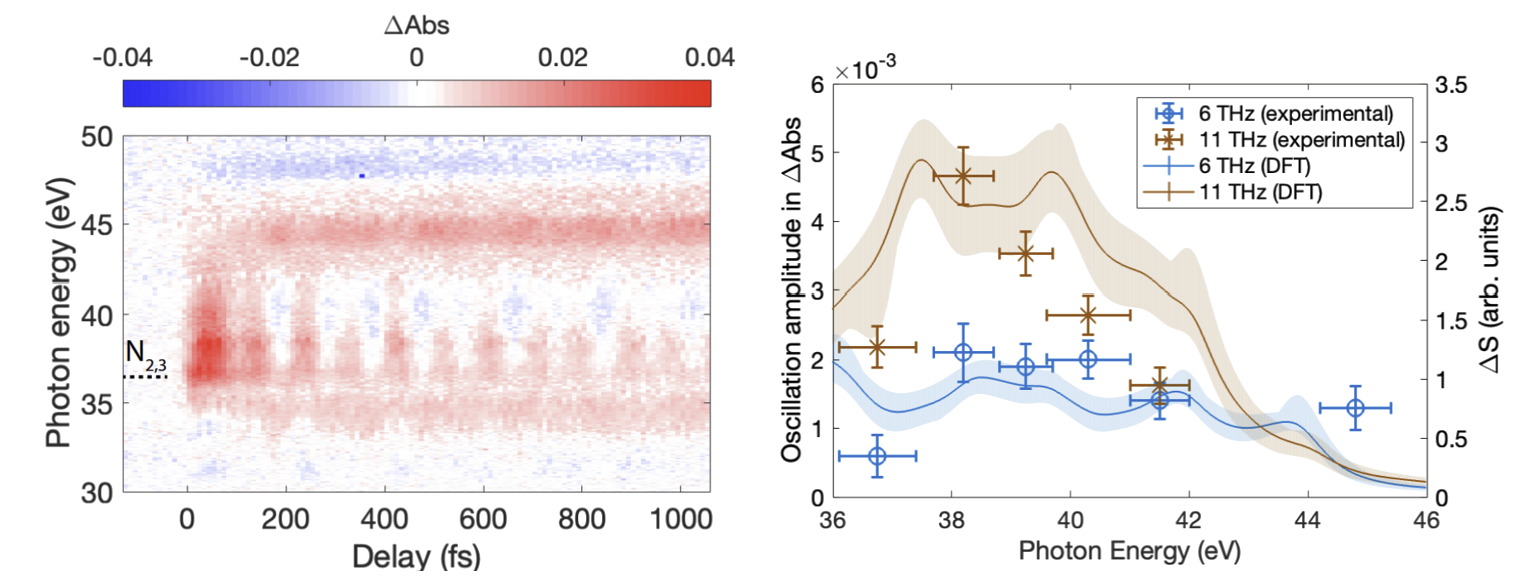
What happens when you take a transition metal with large spin-orbit torque, like β-tungsten, and you excite a hot-electron state with a 10-femtosecond pulse? Interestingly, the material shows an initial response that is dominated by independent electron dynamics, but transitions at later timescales to a screening induced response. In other words, the material shows an ultrafast indepenent-to-correlated electron transition. Specifically, within the first tens of femtoseconds after excitation the dominant effect is simply that excited electrons fill up available states near the Fermi level (Pauli blocking), but on a picosecond timescale the picture changes to one where the excited electrons localize onto the tungsten's outer d-orbitals, screening the core levels. Attosecond transient absorption spectroscopy is the ideal technique to track this response, as it allows the tracking of these dynamics from different atomic core levels, and therefore provides an element, orbital and spin-specific response of the fast electron-electron dynamics on the few-femtosecond scale and the slower electron-phonon thermalization that follows. Understanding these ultrafast electron dynamics is specifically important for technologically relevant metals like β-tungsten. This provides a picture of the temporal limit of electron dynamics, essential for pushing electronic devices toward PHz operating speeds.
E. W. de Vos et al., Ultrafast Transition from State-Blocking Dynamics to Electron Localization in Transition Metal 𝛽-Tungsten. Phys. Rev. Lett. 131, 226901 (2023).
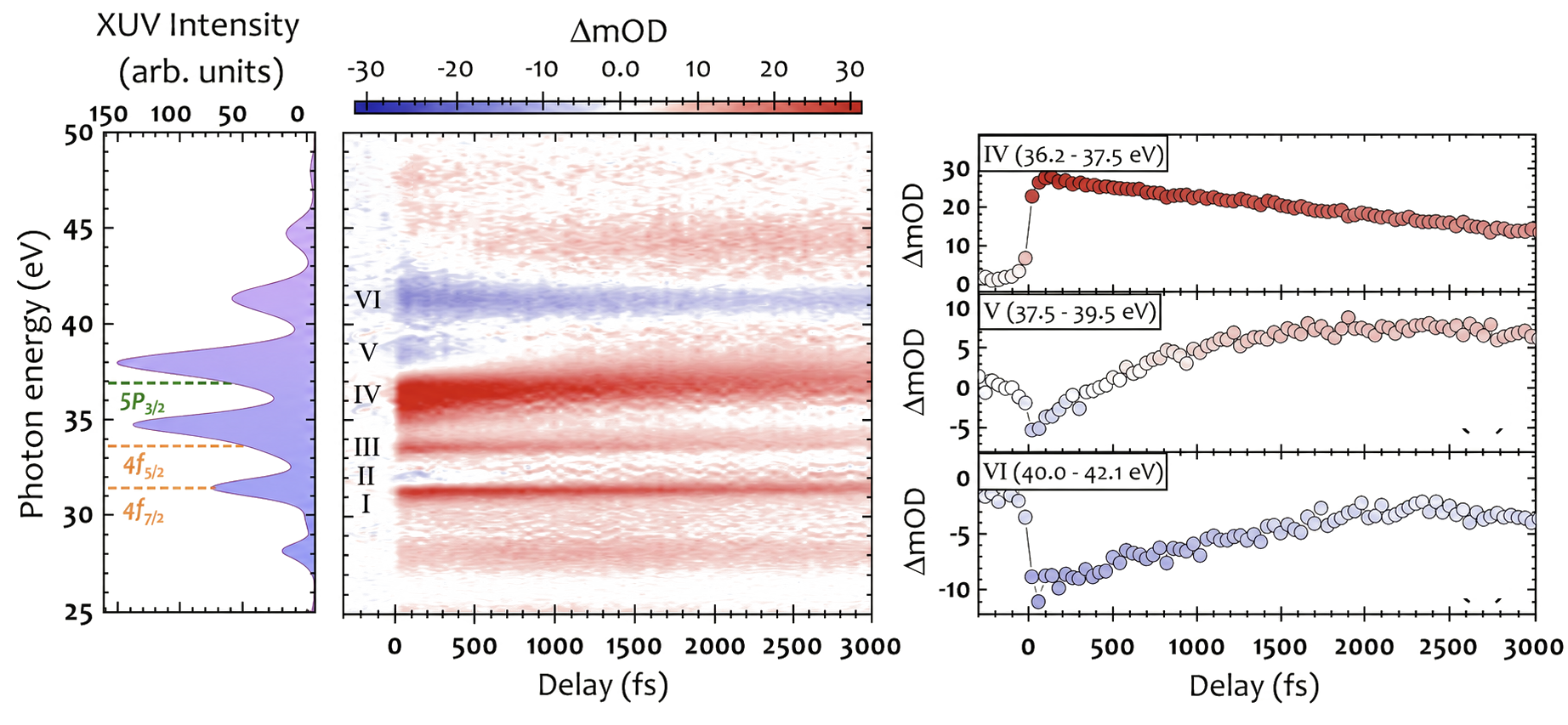
Ultrafast indepent-to-correlated electron transition in large spin-orbit torque transition metal
Ultrafast dynamics from a transparent substrate, through non-thermal heating

Ultrafast dynamics from a transparent substrate, through non-thermal heating

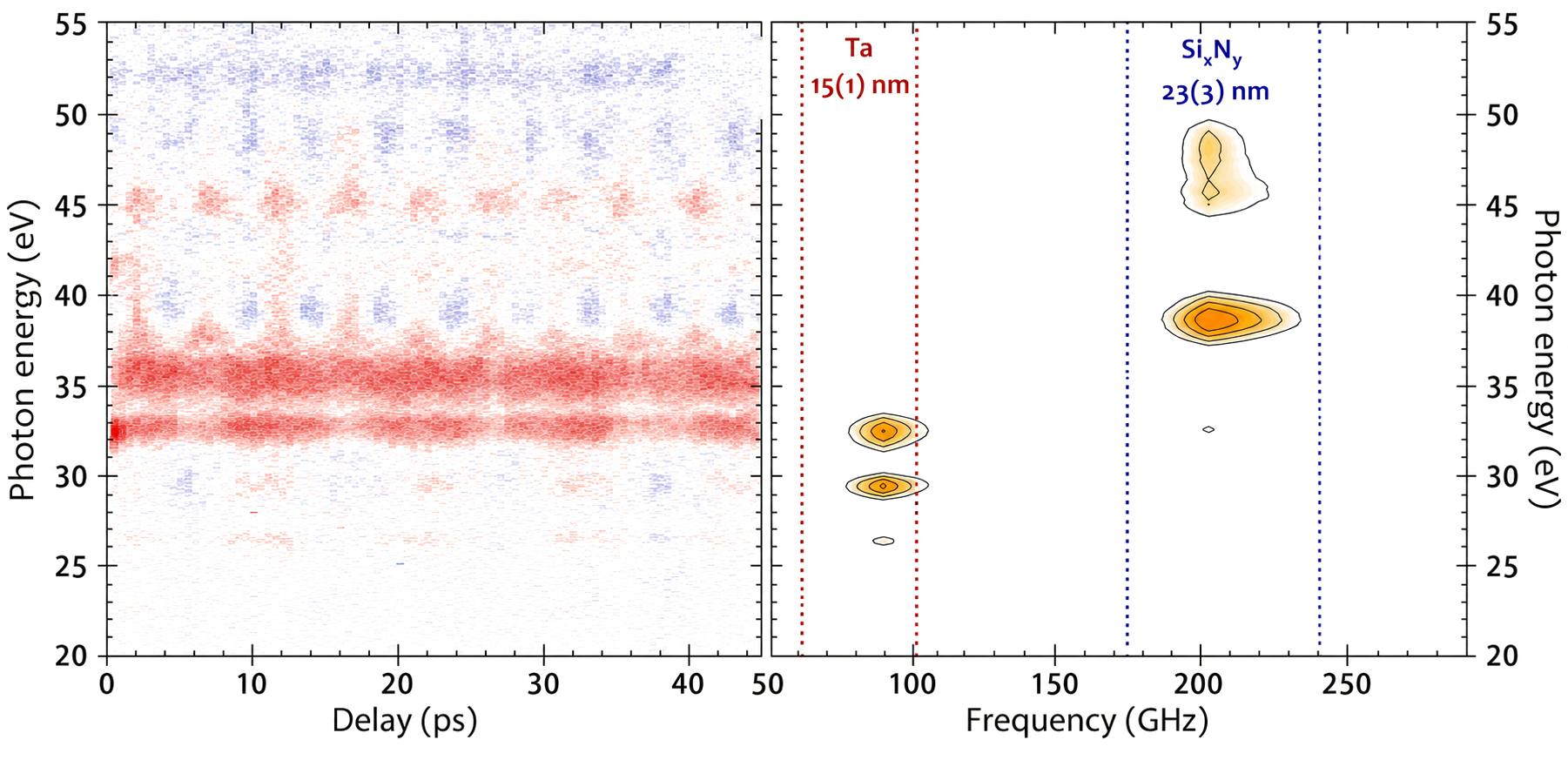
It might seem obvious that in order to heat up a material, you have to put it in contact with heat. It might also seem obvious that you in an optical experiment, you can neglect a response from the substrate if the substrate is transparent to your pump light. However, both of these assumptions can be wrong and this experiment shows that you can in fact expect a phononic substrate response on femtosecond timescales, even when the substrate is transparent. It turns out that electrons that are optically excited in a metal layer (tantalum, in this case) can travel faster than the speed of sound and scatter on the substrate interface. This scattering, in turn, heats up the substrate and can launch an acoustic phonon. In this experiment, it is therefore not phonons (i.e. heat) that carry the heat across the sample, but it is hot electrons. In other words, this is called non-thermal heating. Even though the substrate is transparent to the optical pump pulse, the scattering of hot electrons on its interface with the sample excites dynamics on femtosecond timescales that couple back to the sample dynamics. This experiment therefore shows that everyone should be very careful about ruling out substrate dynamics. They can appear even when you don't expect them to appear at all.
E. W. de Vos et al., Hot-Electron-Induced Substrate Response in Transient Absorption Spectroscopy of Tantalum. Opt. Express 33, 9707 (2025).

Controlling heat generation on sub-femtosecond timescales

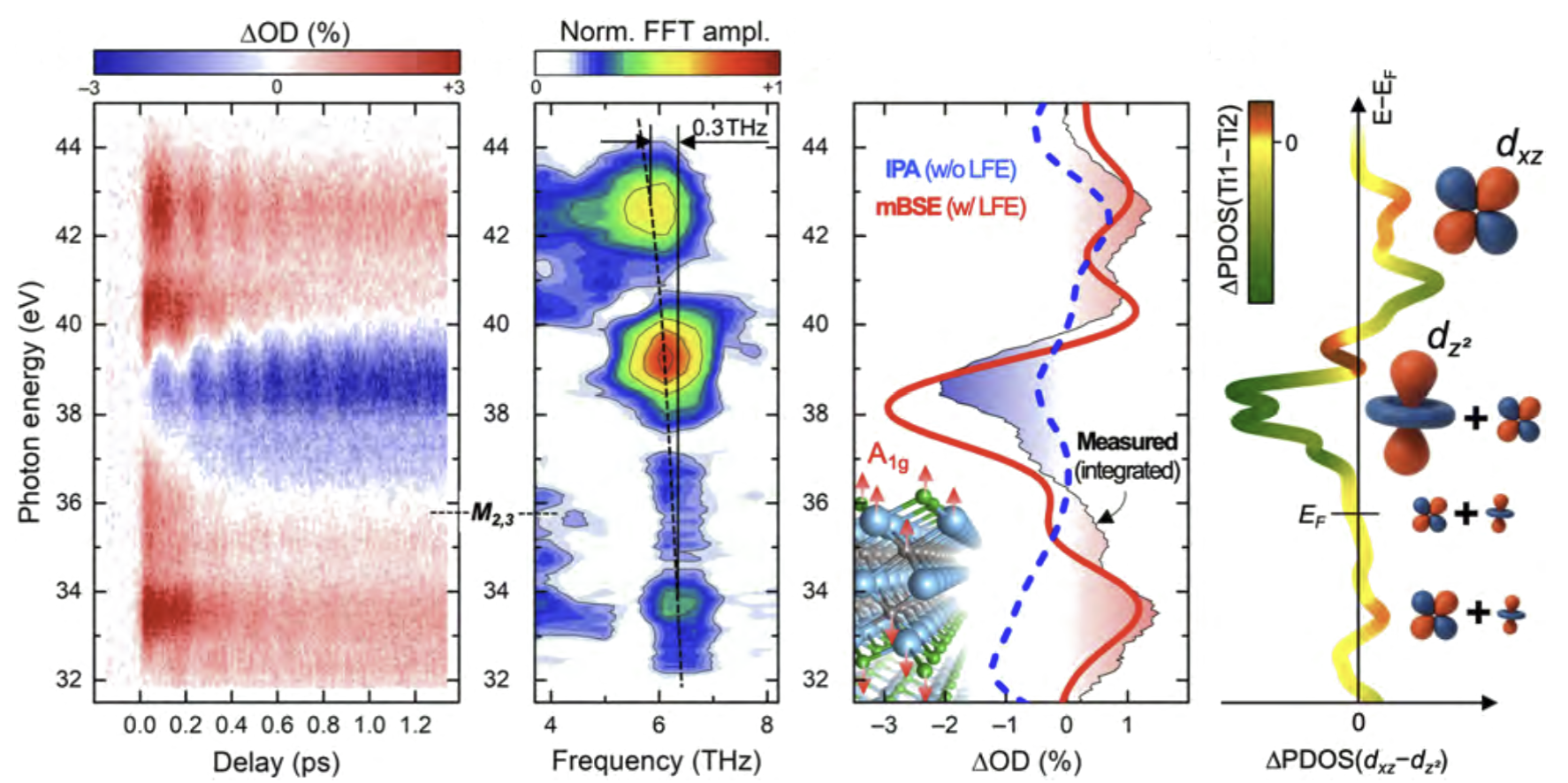
What if we could engineer electronics not just to efficiently dissipate heat after it has been generated, but to actually prevent heat formation itself? This requires the capability to adjust a material's response before phonons, the carriers of heat, have been generated.  In this attosecond transient absorption spectroscopy study of titanium-based metal carbide 'MXenes', it is shown that heat formation can be tailored and steered, on timescales far below what is usually associated with phonon formation. Key to this insight is the understanding of sub-cycle local-field dynamics and spatially resolved time-dependent density functional theory calculations. The optical launch of phonons in MXenes is driven by the ultrafast electron localization onto the titanium d-orbitals and excited through displacive excitation of coherent phonons (DECP) the subsequent phonon dynamics and, therefore, heat. In other words, the phononic response orbital-driven and the phonon formation can be steered by tuning the local-field dynamics
S. Neb et al., Local fields reveal atomic-scale nonadiabatic carrier-phonon dynamics. Science 391, 75 (2026).
Controlling heat generation on sub-femtosecond timescales

Title of this block

Description of papr
Citation

Title of this block

Description of papr
Citation

Title of this block

Description of papr
Citation